
The Problem
We have a motorhome. It’s an older one without any air conditioning in the cab, or in the habitation end. I bought a small, low power electric portable air conditioning unit that will sit between the passenger and driver seats when we’re parked and have an electric hook-up. But that needs to be vented through a 150mm hose which is impractical as the only place to vent it is through an open window.

3D printed air-con window vent adapter
The Solution
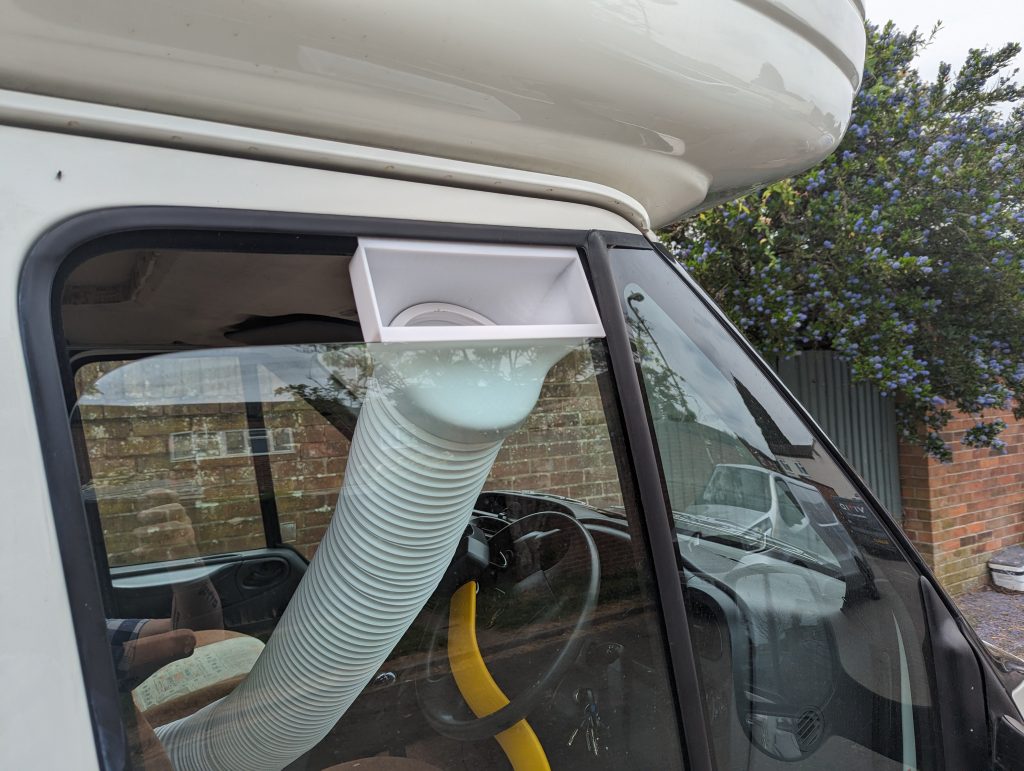
On Thingiverse, there was an exhaust vent already modelled but it didn’t quite work with our unit. The first image shows a ring that came with the air conditioning unit. The second image shows the 3D printed vent with the ring just pushed into the bottom. I was going to screw it together and seal it with silicone. But I figured I’d try to model the ring in Fusion 360 and combine it with the part that I’d downloaded from Thingiverse and 3D print it.
There is a ring round the end of the exhaust hose that the 3 clips on the ring in the first image latch onto so I added these to the model I was designing.
The last image shows the whole part clipped onto the exhaust hose. This will be vented out of a partially opened cab window with the window closed enough to hold it in place.
It’s not perfect. The window being slightly open makes the air conditioner slightly less efficient. The step down from a 150mm round hose to a smaller rectangular vent means a drop in air flow. But this will only be used in the UK in late afternoon/early evening to take the edge of the heat before we go to bed. After that, it cools down sufficiently on its own.
EDIT…
After using this for a few hours, it became obvious that the surface area of the outlet was too small compared to the surface area of the circular hose. You could smell that something on the A\C unit was getting warm. I’m guessing the reduced outlet was creating some back pressure and pushing warm air back into the A/C unit causing it to over heat.
Back to the drawing board and I completely redesigned it from scratch. The MK2 version has a much bigger outlet which matched the surface area of the hose. I ran this for several hours and it’s definitely cured the problem.